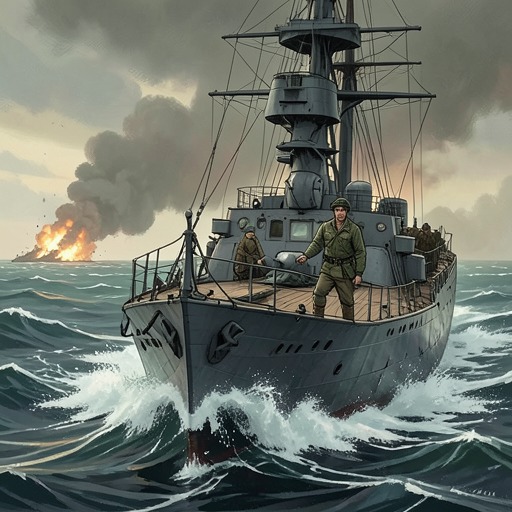
Caine's Failure to Guide Jacob Group Four to the Departure Line
The Caine MutinyThe Caine's Failure to Guide Jacob Group Four to the Departure Line is a botched landing-support assignment during the Battle of Kwajalein. The ship fails to deliver the landing craft to their departure line and leaves them to continue without its guidance. The immediate failure becomes a larger test of judgment: the officers argue over the navigation, while Willie Keith is forced to confront a troubling omission in his own observations of Philip Francis Queeg.
Assignment in the invasion formation
By the beginning of 1944, the war’s major turning points were behind the Allies, and their industrial advantage was growing. That broad strategic picture offered little comfort to Willie Keith, whose view from the Caine was of a ship bound for dangerous Pacific operations. In January, an enormous force of ships sailed from Hawaii toward Kwajalein Atoll. The orderly scale of the formation, maintained by radar and the work of officers on watch, stood in contrast to the uncertain, immediate decisions awaiting the Caine as part of the invasion.
As the ship approached the islands, Queeg asked Willie, who was serving as officer of the deck, to identify the group of landing craft the Caine was supposed to take in. Willie identified the LVTs associated with Jacob Group Four and APA 17, a large transport. Queeg ordered the Caine toward the transport at standard speed and told Willie to keep the conn. The assignment was specific: the minesweeper was to guide the landing craft toward the line of departure, from which they would proceed toward the landing at the designated time.
The boats fall behind
With Queeg out of sight behind the bridgehouse, Willie took control of the ship’s movement. The Caine left its position in the screen and headed toward the transports. As it moved closer to the invasion area, the battleship bombardment grew louder. Willie took bearings, called for radar ranges, and ordered changes of rudder. His confidence in giving those orders was intensified by the pressure and activity around him, but he remained uncertain about what to do when the landing craft began coming toward the ship.
Steve Maryk entered the wheelhouse and recognized the immediate danger: the Caine was about to run down the boats. He ordered all engines stopped, called to the approaching craft through a red cardboard megaphone, and learned that Jacob Group Four was ready to proceed to the point of departure. Queeg then directed Maryk to take the conn and get the ship there. The LVTs followed the Caine across the choppy water toward Enneubing Island, known in the operation as Jacob. Willie could make out features on shore, including a hut, an abandoned rowboat, oil drums, and damaged palm trees. A sailor on the leading boat signaled repeatedly for the Caine to slow down; the men in the craft were being drenched by spray as their boats pitched in the waves.
Queeg questioned what the signal meant, then rejected the request to reduce speed. He maintained that the Caine had to reach the departure line by H-hour and that, if the landing craft could not keep up, the ship would drop a dye marker at the intended position. In the pilothouse, Maryk reported that they were about fifteen hundred yards from the line. Queeg disputed that estimate, insisting that the beach was closer, and challenged the bearing information called out from the bridge. He went to the port wing, checked the alidade himself, and concluded that the ship had already passed the departure point. He ordered right full rudder, full speed ahead, and the marker released.
The Caine heeled into a tight turn and accelerated back along its reverse course. Jacob Group Four’s LVTs were left far astern; a bright yellow stain spread on the water near them. The marker made the intended point visible, but it did not undo the separation: the landing craft and the Caine were no longer together to complete the guidance assignment as planned. The ship had turned away from the boats before they reached the line.
After the maneuver
Later that day, the Caine passed through the channel between Jacob and Ivan with the larger attack force and anchored in the lagoon. Queeg ordered armed guards along the ship’s sides and dismissed the crew from battle stations. Surrounded by other vessels, the Caine had no opportunity to fire on the beach, and the sailors who had spent hours at their posts went below to rest. The invasion was not experienced aboard the minesweeper as a continuous exchange of combat. For Willie, the contrast between the fleet’s immense operation and the Caine’s limited role made the landing an unusual first experience of war.
That evening, the officers discussed the day’s performance. Tom Keefer called attention to Queeg’s turn before the Caine had reached the departure line and to the landing craft left to navigate on their own. The criticism was not simply about the ship’s position. Keefer asked whether Willie had seen Queeg on the side of the bridge exposed to the beach during the operation. Willie realized that he had not. The absence struck him as significant because Queeg had previously tended to remain in the wheelhouse during maneuvers, but Willie could not say that he had watched the captain throughout the day or explain why he had been absent from that side.
Willie initially avoided making a definitive judgment, noting that he had been occupied and that Urban might have misread a bearing. Keefer accused him of protecting Queeg and the Navy rather than facing what the officers had witnessed. He then characterized Queeg as a coward. Maryk objected to Keefer’s accusation, making clear that the officers did not agree on what the day’s events proved. The exchange thus leaves an important distinction intact: the failure to guide the landing craft is observable, while Keefer’s explanation of Queeg’s conduct remains an accusation, not an established fact.
Significance and limits
The episode brings the Caine’s formal assignment into collision with its actual performance. Orders, bearings, a scheduled departure line, and a dye marker give the operation a technical clarity; changing estimates, delayed communication, and the separation of the LVTs reveal how quickly the execution could diverge from that plan. Maryk responds to the immediate risk of running down the boats, while Queeg makes the decision to turn and leave a marker. Willie’s position on deck gives him a partial view of events, not complete knowledge of the captain’s intentions.
The yellow stain gives the incident its enduring shorthand, but it does not settle the dispute it provokes. For Tom Keefer, the maneuver and Willie’s recollection of Queeg’s absence support a grave judgment of the captain. For Willie, the recollection is unsettling precisely because it exposes something he had not considered while occupied with the ship’s navigation. The scene therefore links operational confusion to the officers’ strained trust and to Willie’s difficulty in speaking plainly about a superior. It raises questions about command and responsibility without making his incomplete observation conclusive proof of motive.
The novel’s prefatory note expressly identifies the Caine and the people and events aboard her as imaginary, and warns that specific operational details have been altered. The episode should accordingly be understood as part of the novel’s fictional portrayal of naval command, not as a report of a documented historical landing operation. Within that portrayal, the failed guidance is consequential less as a standalone battlefield result than as an incident the officers interpret differently, revealing the growing divide between Queeg, Maryk, Keefer, and Willie.